
OECT
Vision
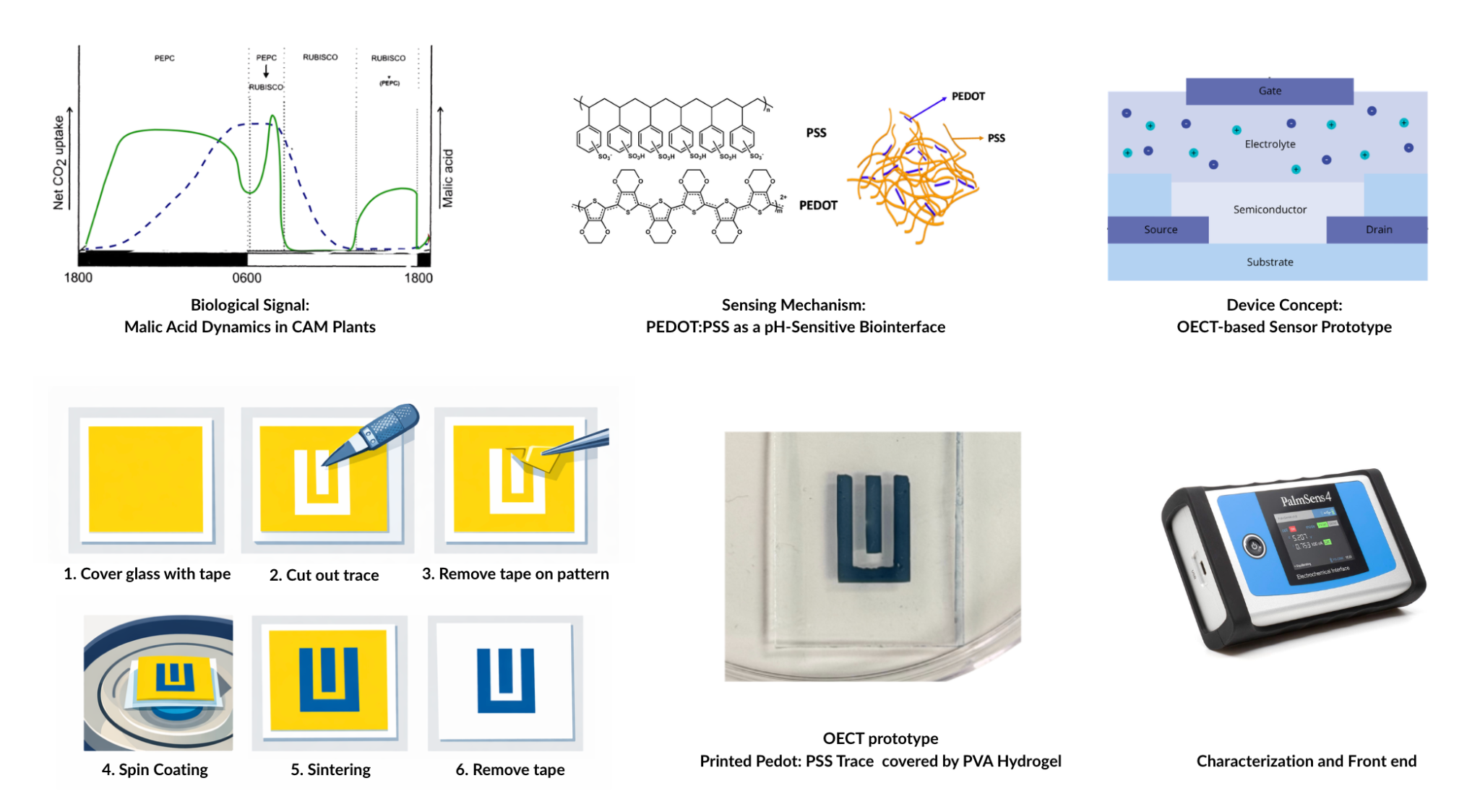
Crassulacean Acid Metabolism (CAM) photosynthesis is a water-conserving approach in which plants convert carbon dioxide to malic acid. While malic acid tracks how a plant regulates its stomata and responds to stress, conventional measurements rely on destructive tissue assays, yielding single-timepoint data.
We are building an organic electrochemical transistor (OECT) that stays on a living plant and monitors malic acid concentration continuously. The target is a biocompatible, stable, and low cost device that runs for weeks to months on the plant.
Progress
PVA Development and OECT Fabrication
Tuned the molecular weights, water ratios, and cross-linking techniques of PVA to develop a stable, stretchable substrate for OECTs. Fabricated both fully PVA-encapsulated all-PEDOT:PSS devices (the ideal final architecture) and glass-based PEDOT:PSS prototypes with Ag/AgCl gates (to establish a reliable testing baseline).
OECT Characterization
Conducted preliminary electrochemical measurements, acquiring transfer curves across varying pH levels (malic acid concentrations) to validate the initial sensor response.
Ongoing Research Questions
Comprehensive device characterization
Validating accurate and quantitative responses to pH levels, and evaluating the intrinsic electrochemical performance of the OECTs.
Structure optimization
Finalizing channel geometries, evaluating potential material upgrades, and transitioning the characterization from Ag/AgCl reference electrodes to a fully integrated gate design.
System construction
Replacing the current lab equipment with microcontroller platforms to enable portable, in situ plant monitoring.
Publications (TBD)
Paper TBD
Team
Ph.D and Postdoctoral
Qitong Li
Masters
Xiaoyu Zheng
Xuanhui Weng
 VAK Embodied Systems Lab